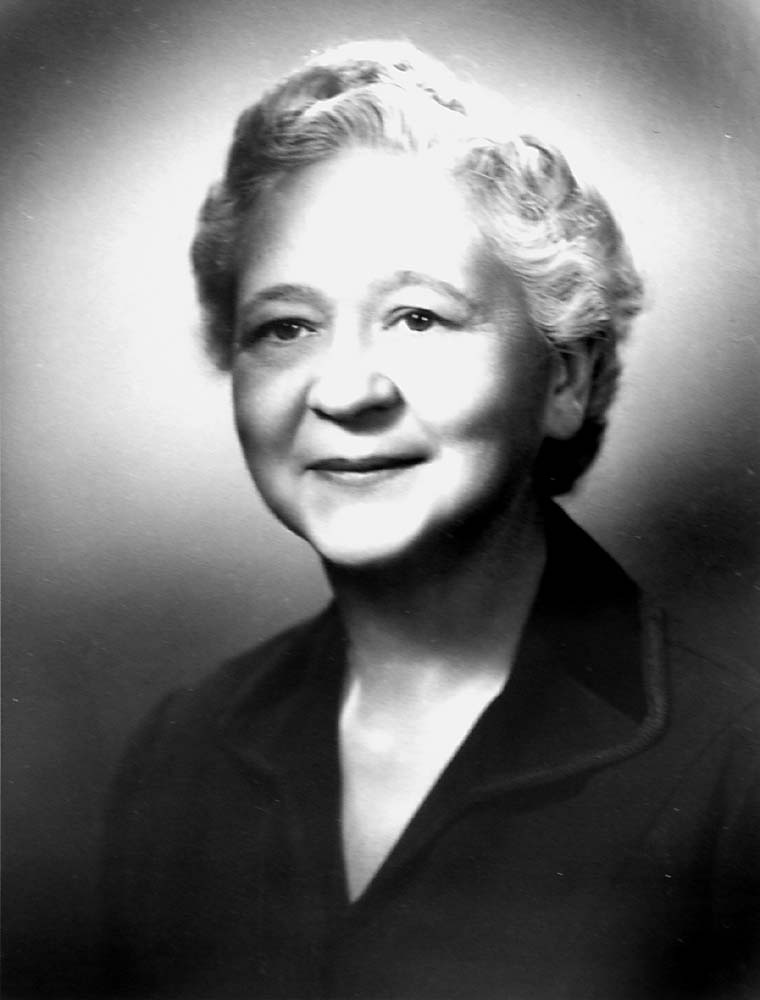

Many in the know, know Mildred as a great favorite of many forensic anthropologists, a remarkable 20th Century woman in science. Dr. Trotter made extraordinary contributions of methods, and programmatic foundations of the science underpinning evidence categories in the applied forensic science field and human bioarchaeology. Professor Trotter’ legacy as a scientist, professional, and colleague becomes more clear through reading her correspondence, work product with war dead identification and the foundations of forensic anthropology. Beyond a citation of published works, we learn from how Dr. Trotter navigated sensitive research subjects and scientific, policy, and human challenges. In her correspondence with T.D. Stewart and Major Stewart Abel in particular we gain insight of the character of Dr. Trotter, intellectual capacity, and humanity among those who knew her as ‘Trot’.
Oral History
https://beckerexhibits.wustl.edu/legacy-exhibits/oral/interviews/trotter.html
Mildred Trotter Papers, Washington University in St. Louis
https://beckerarchives.wustl.edu/FC029
Born in Monaca, Pennsylvania 2 February 1899
Died in St. Louis, Missouri 23 August 19911
Trot’s correspondence and career make clear that she viewed herself as an anatomist, with an early interest in hair, but grounded in the training to understand, demonstrate, and teach human anatomy, apply scientific approaches to understanding the fundamentals of human-kindness and human variation. A telling story that Trot relayed in her 1972 Oral History, is where she describes performing a demonstration dissection/autopsy and being challenged when the individual’s variant anatomy did not conform to the expected normal anatomy. This did not cause Trot to lose confidence that the particular bodily variation was not real, but that her careful dissection did reveal her skill and could be witnessed by other trained observers to be accurate and telling.
Trot took this as both a challenge and opportunity to demonstrate expertise and skill rather than interpret it as demeaning challenge by a possibly biased observer.
- I was working at the Smithsonian Anthropology department at this time in 1991. Dr Stewart would still come into his office one day a week. I knew of the stature formulae, but I do recall the news of her death and discussion about the hair collections and the Terry. I wish I could go back and ask so many questions about her. ↩︎
Leave a Reply